How to Read a Ruler – MM, CM & Inches Explained Simply for Beginners (2026 Guide)
Rulers look simple. Straight line, some markings, numbers. But ask most adults to measure to the nearest millimeter using the small lines on an inch ruler, and they will hesitate. Ask them what 3/16 of an inch looks like, and most will genuinely not know.
This is completely normal. Rulers pack a lot of information into a small space, and nobody actually teaches you how to read them properly – they just hand you one and assume you figure it out. This guide fixes that. We start from zero and build up to reading every marking on both metric and imperial rulers confidently.
Want to measure right now? Try our free Online Ruler tool – calibrated to your screen instantly.
Part 1: The Metric Ruler (CM and MM)
The metric ruler is the easier one to start with because the system is logical: everything divides by 10.
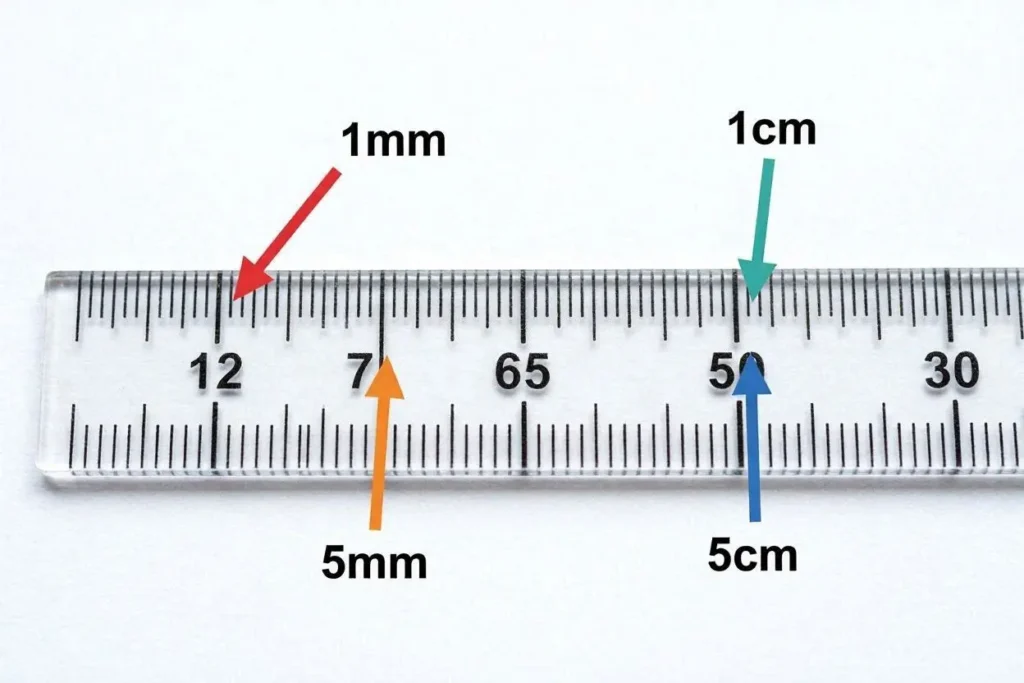
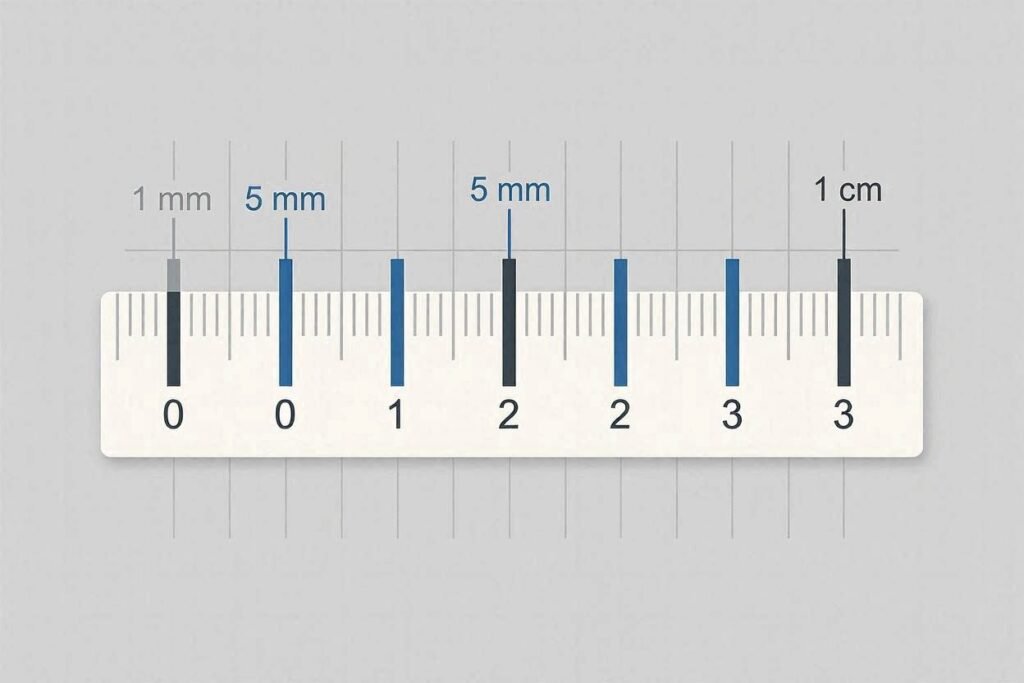
The large numbers you see on the ruler (1, 2, 3, 4…) represent centimeters. Between each pair of large numbers, there are 10 smaller divisions. Each of these small divisions is 1 millimeter.
So the ruler markings go: 1mm, 2mm, 3mm, 4mm, 5mm (slightly longer line – halfway mark), 6mm, 7mm, 8mm, 9mm, 10mm (= 1cm, which is the next large number).
The Line Height System on Metric Rulers
| Line Height | What It Represents | Example |
|---|---|---|
| Shortest lines | 1 mm each | The tiny marks between other marks |
| Medium lines | 5 mm (0.5 cm) | The midpoint line between two CM numbers |
| Tallest lines with numbers | 1 cm each | The main numbered marks: 1, 2, 3… |
How to read a specific measurement: Say something ends at the third small line after the 4 cm mark. That is 4 cm + 3 mm = 43 mm, or 4.3 cm. Always read the large number first, then count the small lines from there.
Part 2: The Inch Ruler (Imperial)
Inch rulers are more complex because the system uses fractions rather than decimals. Instead of dividing by 10, it divides by 2, then by 2 again, then again.
Starting from the largest marks going down:
- Whole inch marks – the tallest lines with whole numbers (1, 2, 3…)
- 1/2 inch marks – one line between each whole inch, slightly shorter
- 1/4 inch marks – three lines splitting the inch into quarters (1/4, 2/4=1/2, 3/4)
- 1/8 inch marks – seven lines splitting each inch into eighths
- 1/16 inch marks – fifteen very short lines splitting each inch into sixteenths
The fraction marks get shorter as they get smaller. This is the key to reading them – the shorter the line, the smaller the fraction it represents.
Reading Fractions on a Ruler – The Most Confusing Part
Let us say your measurement lands on the second line past the 2-inch mark, and those lines are 1/8-inch divisions. You count: first line = 1/8, second line = 2/8. And 2/8 simplifies to 1/4. So your measurement is 2 and 1/4 inches (written as 2¼”).
| What You Count Past a Whole Number | Fraction | Decimal Equivalent |
|---|---|---|
| 1 of the 1/16 lines | 1/16″ | 0.0625″ |
| 2 of the 1/16 lines | 2/16″ = 1/8″ | 0.125″ |
| 4 of the 1/16 lines | 4/16″ = 1/4″ | 0.25″ |
| 6 of the 1/16 lines | 6/16″ = 3/8″ | 0.375″ |
| 8 of the 1/16 lines | 8/16″ = 1/2″ | 0.5″ |
| 10 of the 1/16 lines | 10/16″ = 5/8″ | 0.625″ |
| 12 of the 1/16 lines | 12/16″ = 3/4″ | 0.75″ |
| 14 of the 1/16 lines | 14/16″ = 7/8″ | 0.875″ |
Tip: Most practical measurements do not need to go down to 1/16 inch. For furniture, cooking, and general DIY, reading to the nearest 1/8 inch (0.125 inches) is more than sufficient.
How to Measure an Object Correctly
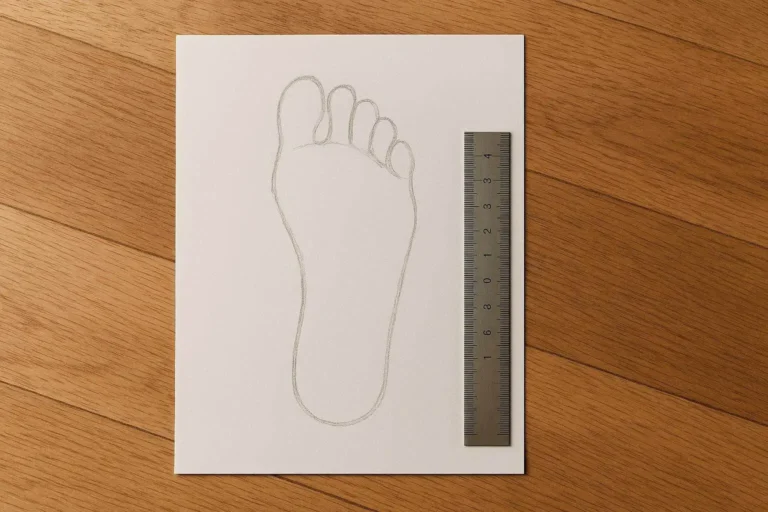
- Always start from the 0 mark, not from the physical end of the ruler. Many rulers have a small gap before the 0 mark – measuring from the edge instead of 0 adds error.
- Hold the ruler flat against the surface of what you are measuring. Tilting the ruler at an angle gives a longer reading than the object’s true length.
- Align the ruler along the longest dimension of the object, not at an angle to it.
- When reading the measurement, bring your eye directly above the marking – looking from the side creates parallax error where your line of sight skews the reading.
- For objects that move or roll, hold them against a straight edge (wall, table corner) and then measure with the ruler.
Common Mistakes When Reading a Ruler
| Mistake | Result | Fix |
|---|---|---|
| Starting from the ruler’s physical end instead of 0 | Measurement too large by the gap amount | Always align the 0 mark with your start point |
| Reading from the wrong side of a double-sided ruler | Completely wrong unit (inches vs cm) | Check which scale you are on before reading |
| Counting lines from 0 instead of from the last whole number | Lost count on long measurements | Read the whole number first, then count from there |
| Viewing the ruler from an angle (parallax error) | Reading shifts slightly left or right | Look straight down at the measurement point |
| Confusing 1/2-inch mark with 1-inch mark | Measurement out by 0.5 inches | The 1/2 mark is shorter than the whole-inch marks |
Using an Online Ruler When You Do Not Have a Physical One
If you need to measure right now and no physical ruler is available, a digital one works well for most practical purposes.
The Online Ruler at onlineruler.online shows both metric (CM, MM) and imperial (inches) scales simultaneously, calibrated to your screen’s PPI. You can switch between scales with one click, and the ruler extends across your full screen width – useful for measuring larger objects.
If you need to convert a measurement from CM to inches or vice versa after reading it, the Unit Converter handles the conversion instantly.
For measuring directly on your screen without any physical tool, try our Screen Ruler feature as well.
Frequently Asked Questions
Some rulers – especially ones used in schools – have a blank edge section before the 1 mark. This is a design quirk from certain manufacturers. Always check: if there is no explicit 0 mark, measure from the very beginning of the first marking, not the physical edge.
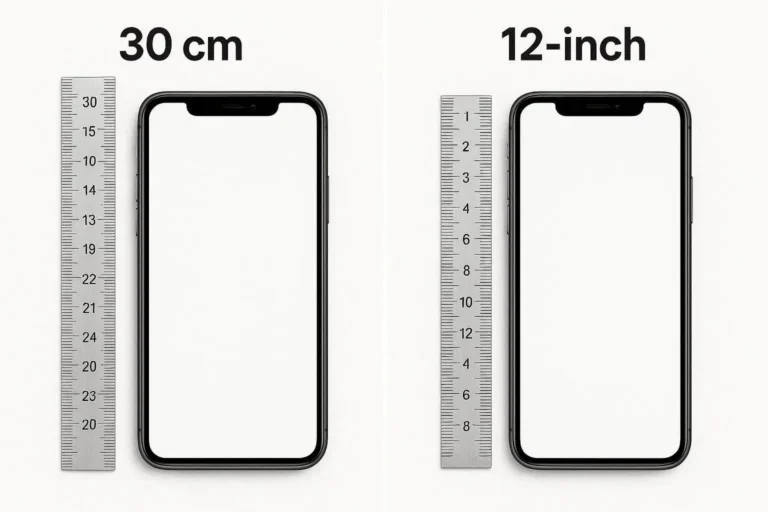
A ruler is rigid and usually 30 cm (12 inches) long – used for flat surfaces. A tape measure is flexible and much longer (3 to 10 meters typically) – used for curved surfaces, longer distances, and situations where you need to measure around corners.
Yes, if the ruler is properly calibrated. The Online Ruler at onlineruler.online uses credit card calibration to match your screen’s actual pixel density. Always calibrate first and verify by checking a known object (like your credit card at 85.6mm x 54mm).
MM is better for precision. Measuring to the nearest 1 MM means your error is at most 0.5 MM, which is smaller than most human construction tolerances. CM forces you to use decimal points (4.3 cm) which is harder to read quickly. For woodworking, jewelry, and electronics, always work in MM.
Now you know exactly how to read a ruler – whether it’s metric, imperial, or on your screen. Bookmark this guide, or better yet, head over to our Online Ruler to start measuring right away.