How to Find Your Shoe Size at Home – Measure in CM & Convert to US/UK/EU
You found the perfect pair of sneakers on an international site. The price is right, the design is exactly what you wanted and then it hits you: am I a US 9, a UK 8, or an EU 42? Which one do I even order?
Most people guess. Most people get it wrong. A shoe that is half a size too small ruins your posture and your mood by lunchtime. A shoe too big slips off and gives you blisters. Neither is something you want to deal with after waiting two weeks for delivery.
The good news is that measuring your foot size at home takes under five minutes and requires nothing but a piece of paper, a pen, and a ruler – or just your screen. This guide walks you through every method clearly, with conversion charts for US, UK, EU, and even Pakistani and Indian sizing standards.
Why Shoe Sizes Vary by Country (And Why It Matters)
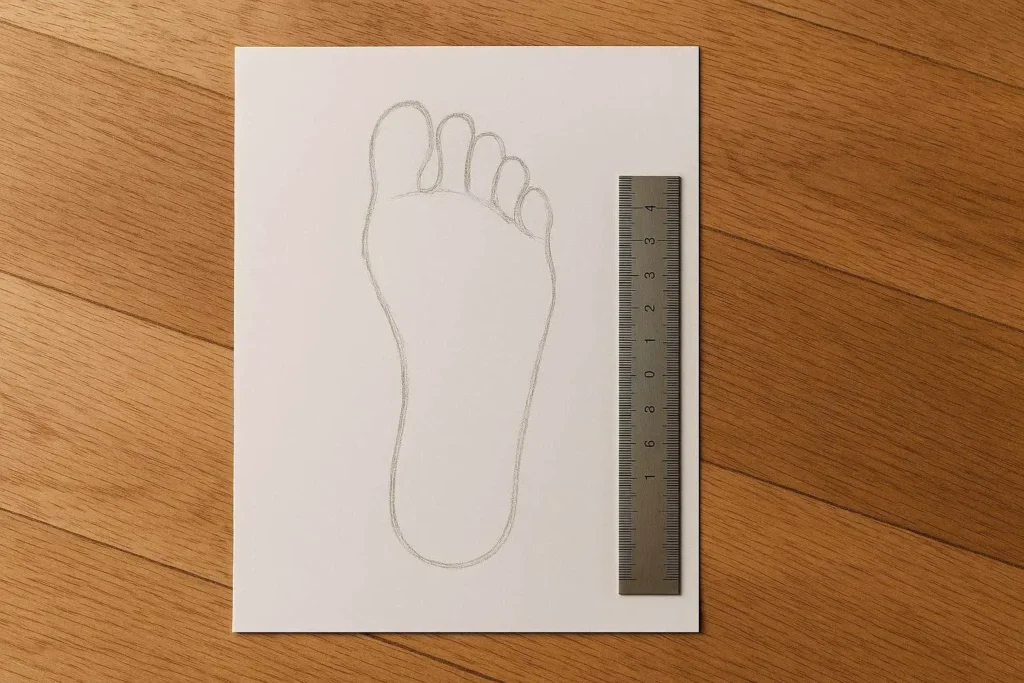
Here is something that surprises most people: a US Men’s size 10 is NOT the same as a UK Men’s 10. They are actually different sizes. The US and UK systems both use inches as their base but apply different starting points – so the same foot ends up with a different number depending on where you are shopping.
The EU system uses Paris Points, which are roughly two-thirds of a centimeter. The Japanese system uses your foot length in centimeters directly. The Indian and Pakistani market largely follows the UK system but can vary by brand.
This is exactly why measuring in centimeters first is the smartest move. Centimeters are universal. Once you have your foot length in CM, you can convert to any system accurately – no guessing, no brand-specific exceptions to memorize.
What You Need
- A blank sheet of A4 or any plain paper
- A pen or pencil
- A ruler – or the free Online Ruler at onlineruler.online if you have no physical ruler
- Socks (measure with socks on if you normally wear them in shoes)
Method 1: The Paper Tracing Method (Most Accurate)
This is the standard method used by professional shoe fitters worldwide. It works because you are measuring the actual silhouette of your foot rather than estimating.
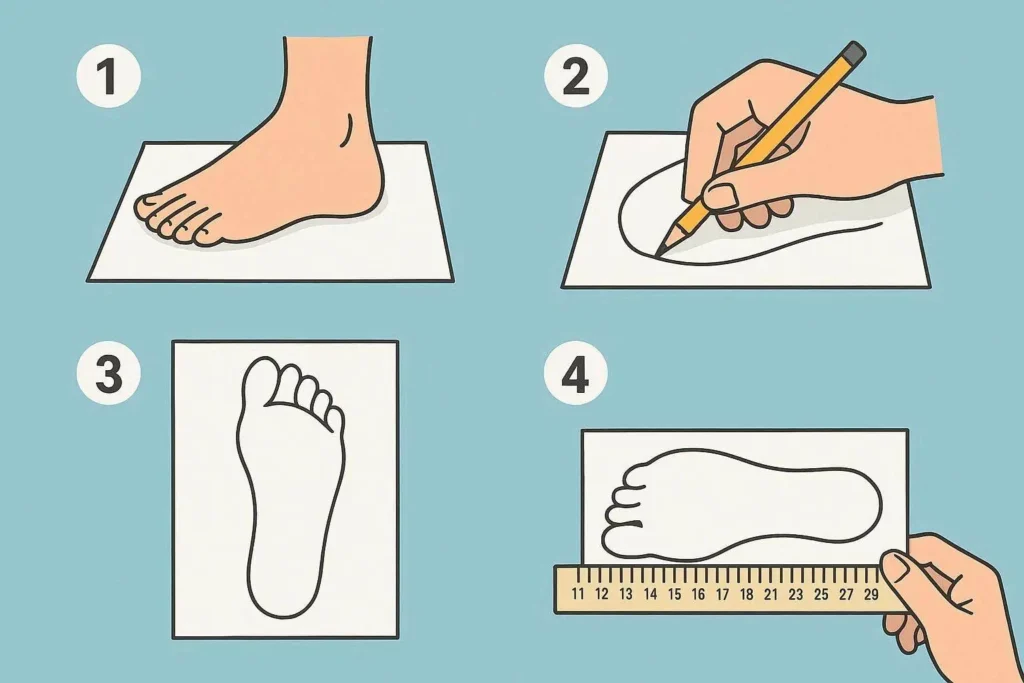
- Place a blank sheet of paper on a hard, flat floor. Avoid carpet – it compresses and changes your foot shape.
- Stand on the paper naturally. Do not lean forward or backward. Keep your weight evenly distributed the way you normally stand.
- Hold a pen vertically and trace all the way around your foot. Keep the pen touching your skin at all times – do not angle it outward.
- Step off and draw a straight line across the widest part of your traced outline (usually just behind the toes). Draw another line at the very tip of your longest toe.
- Measure the distance between these two lines. This is your foot length in centimeters.
- Also measure the widest part across your foot – this is your foot width, which determines whether you need a wide or narrow fit.
Important: Always measure both feet. Most people have one foot slightly larger than the other. Always buy for the larger foot – you can add an insole for the smaller one, but you cannot make a shoe bigger.
Also measure in the evening. Feet naturally swell throughout the day from walking and standing. Morning measurements can be up to half a size smaller than evening measurements.
Method 2: Use a Ruler Directly (Quick Version)
If you do not have paper handy, you can measure directly. Sit on a chair with your foot flat on the floor. Place your heel against a wall and use a ruler on the floor to measure from the wall to the tip of your longest toe. This gives you your foot length directly in centimeters.
This method works well when you already have a ruler. If you do not, use the free Online Ruler at onlineruler.online – it works on any screen and does not require any app or download.
Shoe Size Conversion Chart
Once you have your foot length in CM, find your size below:
| Foot Length (CM) | US Men | US Women | UK | EU | India/Pak (approx) |
|---|---|---|---|---|---|
| 22.0 cm | 4 | 5.5 | 3.5 | 36 | 3.5 |
| 22.9 cm | 5 | 6.5 | 4.5 | 37 | 4.5 |
| 23.5 cm | 5.5 | 7 | 5 | 38 | 5 |
| 24.1 cm | 6 | 7.5 | 5.5 | 39 | 5.5 |
| 24.8 cm | 6.5 | 8 | 6 | 39-40 | 6 |
| 25.4 cm | 7 | 8.5 | 6.5 | 40 | 6.5 |
| 26.0 cm | 7.5 | 9 | 7 | 41 | 7 |
| 26.7 cm | 8 | 9.5 | 7.5 | 42 | 7.5 |
| 27.3 cm | 8.5 | 10 | 8 | 42-43 | 8 |
| 27.9 cm | 9 | 10.5 | 8.5 | 43 | 8.5 |
| 28.6 cm | 9.5 | 11 | 9 | 44 | 9 |
| 29.2 cm | 10 | 11.5 | 9.5 | 44-45 | 9.5 |
| 29.8 cm | 10.5 | 12 | 10 | 45 | 10 |
| 30.5 cm | 11 | 12.5 | 10.5 | 46 | 10.5 |
For faster conversion, use the Shoe Size Converter at onlineruler.online/shoe-size-converter/ – enter your CM measurement and it shows all international sizes at once.
Method 3: Use the Free Online Shoe Size Converter
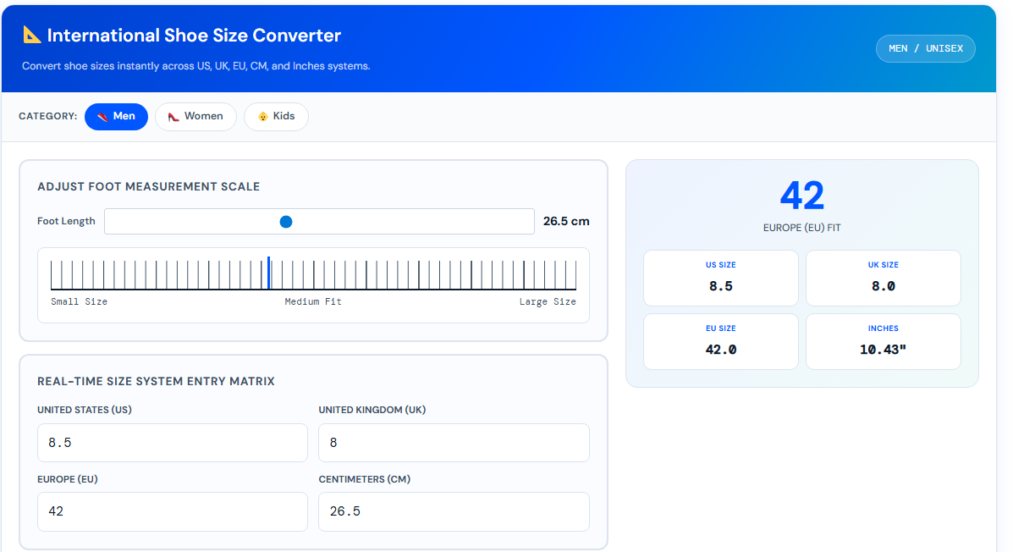
If you already know your size in one system and just need to convert to another, the online tool does this instantly. Enter your US, UK, or EU size and it gives you the equivalent in every other system – including the CM foot length so you can verify with the chart above.
Open Online Shoe Converter on your phone or laptop. Select your gender, enter your known size, and see all conversions in one view. No sign-up. No fees.
Tips for Buying Shoes Online Without Trying Them On
- Always read the brand’s own size guide – some brands run large or small compared to standard charts
- Check whether the sizing is for the insole length or the outer shoe length – these differ by 1-1.5 CM
- If you are between sizes, go up for closed-toe shoes and down for sandals or open styles
- For athletic shoes, add 0.5 CM to your measured length – your foot expands when running
- Read recent reviews specifically about sizing – they often mention if a model runs small
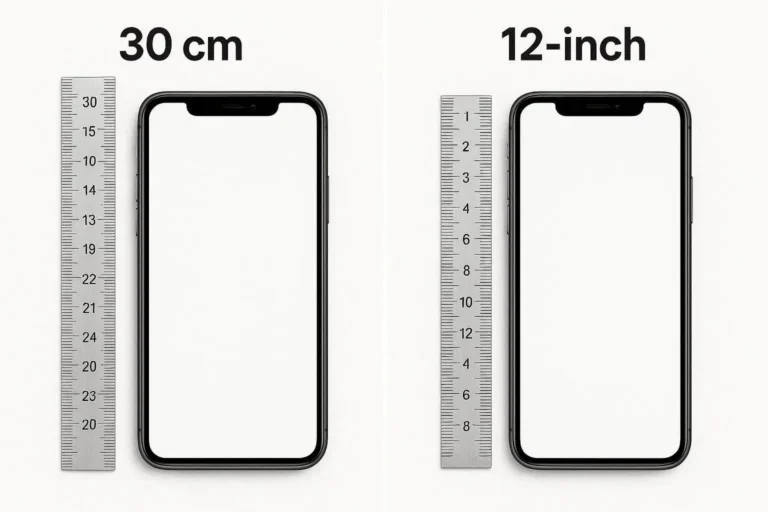
Also helpful: once you have your measurements written down, convert CM to inches using the Unit Converter – useful when a brand lists sizes in inches rather than CM.
Common Mistakes People Make
| Mistake | What Goes Wrong | Fix |
|---|---|---|
| Measuring in the morning | Feet are smallest after sleep – shoe will feel tight by afternoon | Always measure in the evening |
| Measuring on carpet | Carpet compresses your foot and gives shorter measurements | Measure on a hard floor only |
| Not wearing socks | Socks add 2-4mm – shoe will feel tight if you wear socks normally | Measure with the socks you plan to wear |
| Only measuring one foot | Most people’s feet differ slightly in size | Measure both, buy for the larger foot |
| Trusting one brand’s size for all brands | Sizing varies significantly between manufacturers | Always measure fresh for each new brand |
Frequently Asked Questions
Always go with the larger size for closed shoes. You can add a thin insole to fill a slightly large shoe, but nothing can be done about a shoe that is too small except returning it.
No. A US Women’s 8 is approximately a US Men’s 6.5. Most international size charts list men’s and women’s sizes separately. Always confirm which gender sizing the product is listed in.
EU sizing is more standardized than US/UK, but individual brands still have variation in how they cut and last their shoes. The CM measurement is always the most reliable reference.
Based on regional data, the most common women’s foot length in Pakistan falls between 23 and 25 CM, corresponding to roughly UK 4.5 to UK 6 or EU 37 to EU 39.
Final Word
Shoe shopping online is only stressful when you are guessing at your size. Five minutes with a piece of paper and a pen – or thirty seconds with the online converter – removes all the uncertainty. Measure once, measure right, and buy with confidence.
Need to measure something else while you are at it? The main Online Ruler measures anything in CM, MM, or inches directly on your screen. And if you need to convert your measurements, the Unit Converter handles CM to inches, MM to CM, and more – all free, no downloads.